
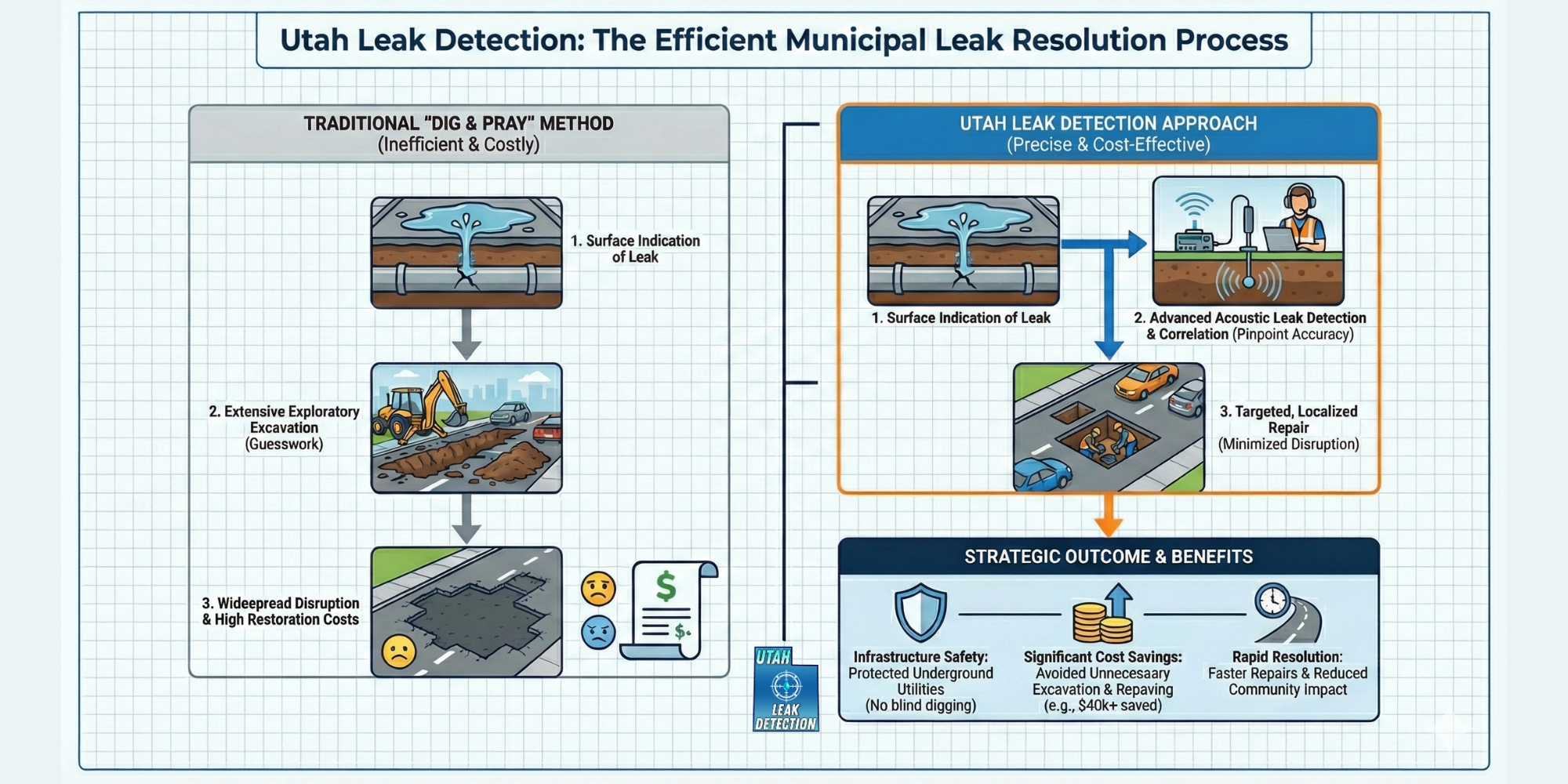
TL;DR: How We Found the Leak Without Destroying the Street
Recently, the team at Utah Leak Detection was called out to tackle a massive challenge: locating a severe leak inside a 24-inch municipal water main.
This wasn’t a standard residential call. The compromised pipe was buried directly beneath the asphalt at the highly trafficked intersection of 5600 West and 3100 South. Tearing up a busy crossroad unthinkingly to find a leak isn’t just an administrative nightmare—it creates severe traffic bottlenecks, disrupts local businesses, and costs a fortune in excavation and repaving.
Our goal is always to find the most efficient, economically feasible solution for our clients. We love seeing the relief on a customer’s face when they realize how much money our precise pinpointing saves them compared to the traditional Guesswork used by some competitors. But this particular project carried an extra layer of satisfaction: because the city contracted us, we were protecting public funds directly.
By pinpointing the exact location of the water main failure without unnecessary trenching, we saved local taxpayers an estimated $40,000. Here is a look at how we handle large-scale municipal leaks and the core principles that guide our process.
Whenever we are called upon to locate and repair a leak in a major water main, there are several key priorities we put above all others to ensure the job is done right.
Water follows the path of least resistance. The spot where water bubbles up through the street is rarely the exact location of the broken pipe. Instead of bringing in heavy machinery to rip up massive sections of the road, we rely on advanced acoustic leak detection equipment and correlators. We map the sound frequencies of the pressurized water escaping the pipe, allowing us to mark the exact point of failure within inches.
A busy intersection like 5600 W and 3100 S cannot afford to be shut down for days. By identifying the exact location of the leak beforehand, repair crews only need to cut a single, localized hole in the pavement. This keeps traffic moving, reduces the time water needs to be shut off to surrounding neighborhoods, and drastically speeds up the entire repair timeline.
Excavation is expensive. Repaving a destroyed intersection is even more expensive. Every square foot of asphalt that doesn’t need to be replaced is money kept in the city’s—and the taxpayers’—pockets. Furthermore, finding these leaks rapidly is critical for water conservation. According to the U.S. Environmental Protection Agency (EPA), household leaks alone waste nearly 1 trillion gallons of water annually nationwide—and municipal main line breaks add exponentially to that loss. Fast, accurate detection stops this massive waste of a precious natural resource.
Digging blind is incredibly dangerous. The ground beneath a major road is a web of gas lines, fiber optic cables, and sewer pipes. Precise leak detection means the excavation crew knows exactly where they are going, mitigating the risk of striking other critical underground utilities.
How do professionals find water main leaks under concrete? Specialists use non-invasive technology, primarily acoustic leak detection. Pressurized water escaping a cracked pipe creates a distinct high-frequency sound. Using sensitive ground microphones and correlators, technicians can listen through concrete and asphalt to pinpoint the loudest source at that frequency, indicating the exact location of the leak.
Why shouldn’t you just dig where the water is pooling? Because water travels along the path of least resistance underground, it will often flow along the outside of the pipe or through loose soil before surfacing. The visible puddle or sinkhole can sometimes be dozens of feet away from the actual crack in the pipe.
Whether it is a 24-inch main line under a major highway or a half-inch copper pipe beneath your kitchen slab, the physics of finding a leak remain the same. It requires specialized technology, deep local experience, and a commitment to doing the job right the first time.
If you suspect you are losing water, don’t wait for the bill to skyrocket or the damage to spread. Get the exact answers you need, before a single shovel hits the dirt.